
Find your way back to each other.
The same argument on repeat. Feeling miles apart even when you're in the same room. Amy Manuele, LCSW works with couples to get underneath the surface conflict — and find what's actually driving the distance.

Amy Manuele, LCSW
Trauma-informed couples & relational therapy
It's not about the dishes — and you both know it.
The same argument, different day
You've had this fight before. Different words, same hurt. You both know what's coming before it starts — and neither of you knows how to stop it.
Roommates, not partners
The closeness faded somewhere. You share logistics, a schedule, a house — but you can't remember the last time you felt genuinely connected.
One pursues, one withdraws
One of you needs more. One of you needs space. The cycle repeats, nobody wins, and both of you feel alone in the relationship. This pattern has a name — and it can change.
Work comes home with you
For military and first responder couples: what you carry from work doesn't stay at work. The hypervigilance, the shutdown, the emotional distance — your partner feels it even when you say nothing.
The space between doesn't hold still. It widens.
Every unrepaired argument leaves a little more scar tissue. The silences get longer, the assumptions get harder, and the version of each other you're reacting to drifts further from the person actually in the room. Couples rarely fall apart in one dramatic moment — they erode, one miscommunication at a time, until “we're basically roommates” quietly becomes “I don't know how we got here.” The longer the pattern runs unspoken, the more normal the distance starts to feel. But the same cycle that pulled you apart can be understood — and undone.
What's driving it — in both of you
Amy brings her deep background in individual trauma therapy into her couples work. She understands that most of what drives conflict in a relationship started before the relationship did — in each partner's own history.
She's trained in PIT (Pia Mellody's model), which specifically addresses the relational wounds that quietly drive couples apart: codependency, boundary issues, self-esteem, and the patterns of connection we learned — or didn't — early on.
The work isn't about assigning blame or coaching you through communication scripts. It's about understanding that each of you is carrying their reality into the relationship — and building a viable bond from there.
Every relationship hits a point where something has to change
Military Couples & Families
Deployment, reintegration, the emotional labor of supporting a service member — or being one. Amy has training in trauma and understands the dynamics military families carry.
First Responder Couples
Police, fire, EMS — the job follows you home whether you want it to or not. Amy helps couples understand how first responder stress shows up in the relationship, and how to find each other again.
Couples Navigating Addiction
Addiction in a relationship — active or in recovery — changes trust, communication, roles, and intimacy. Amy's background in addiction and relational trauma makes this a specialty she holds with particular care.
Communication & Trust
Disconnection, betrayal, feeling unheard or unseen. Couples stuck in a cycle — or those who want to strengthen what's good before it fractures. You don't have to be in crisis to come in.
This is what shifts when couples do the real work
You stop reacting and start responding
Understanding why you react the way you do — not just in the moment, but where it comes from — changes how you show up in conflict.
You actually hear each other
Not just the words — the need underneath the words. Communication changes when both people feel safe enough to say what's actually true.
You rebuild on something real
Not a script or a set of rules — actual understanding of each other. Relationships that survive difficulty usually come out with something stronger than what they started with.
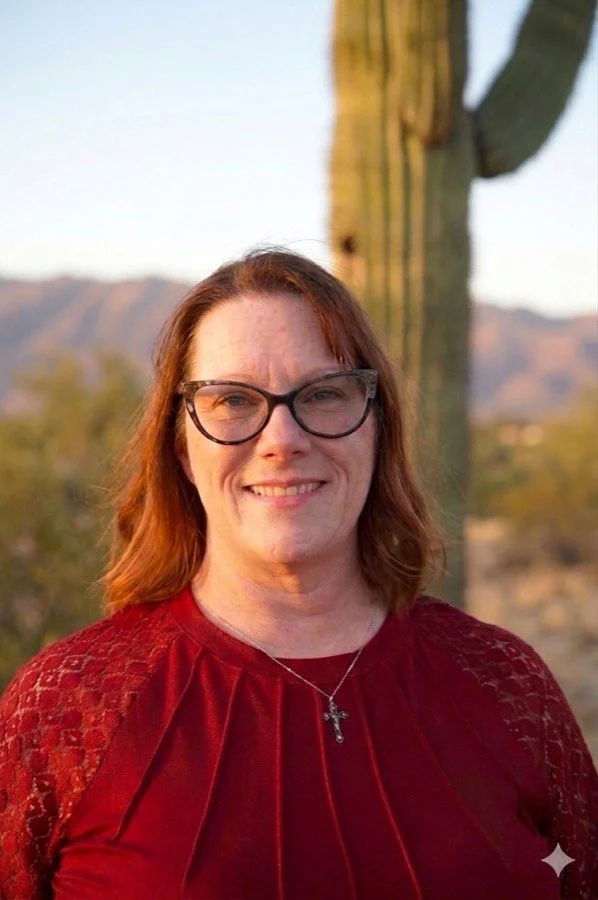
Amy Manuele, LCSW
Licensed Clinical Social Worker · Wickenburg, AZAmy came to couples with a trauma lens — and that lens shapes everything she does with couples. She understands that what happens between two people is almost always rooted in what happened to each person before they met.
Her training includes PIT (Pia Mellody's model) — a framework specifically designed to address relational wounds, codependency, and self-esteem — alongside EMDR, IFS, CBT, DBT, and ART. She's also completing Frank Anderson's IFS Trauma Treatment Program.
Before her clinical practice, Amy worked in K–12 schools, hospital settings, and on a kidney transplant team — environments that required deep skill in meeting people in crisis and navigating complex relational dynamics.
Not your standard couples counseling
A trauma-informed lens on the relationship
Amy treats the two people, not just the argument. What each of you carries from before the relationship is usually where the real change starts.
PIT — built for relational wounds
Trained in Pia Mellody's model, Amy works directly with the codependency, boundary, and self-worth patterns that quietly drive couples apart — not just communication scripts.
Built for service families
Military and first responder couples carry a kind of stress most therapists never see up close. As a military spouse herself, Amy understands — not just professionally, but personally — what it means to have the job follow you home, and into the relationship.
How we work together — step by step
Reaching out together can feel like a big step. Here's how the process unfolds, with no pressure on either of you.
Free Consultation
A 15-minute call. Come together or one of you can reach out first — either is fine. Just a chance to see if Amy's a good fit before committing to anything.
First Session — Setting the Foundation
Establishing safety for both partners: what you're each hoping for, what you're worried about, and what ground rules will help the work actually be productive.
Understanding What Each Person Carries
Before fixing the relationship, Amy works to understand what each partner is bringing into it — their history, patterns, and wounds. This is where the picture comes together.
Building New Patterns Together
Evidence-based tools, applied to your specific dynamic. The goal isn't a better script — it's a different way of knowing and understanding each other that's actually sustainable.
Clear & upfront
Amy does not currently accept insurance. Reach out to discuss any fee questions before your first appointment.
In person & across Arizona
In-Person Office
130 E Yavapai St., Unit 3
Wickenburg, AZ 85390
Telehealth
Arizona statewide · Licensed in AZ
The things couples ask before reaching out
What if my partner won't come to therapy?
You're welcome to reach out for the free consultation on your own — sometimes one partner makes the first call. But couples therapy works with both people in the room, so the next step is bringing your partner in. If they're hesitant, that's something Amy can help you think through on the consultation. (Amy keeps her couples work and any individual work separate, so she won't see one of you one-on-one while also working with you as a couple.)
Are you going to take sides?
No. Amy isn't there to referee or decide who's right. The work is about understanding what each of you is carrying and why the cycle keeps repeating — so you can both feel heard, not judged.
Is it too late if we're already talking about separating?
Not necessarily. Couples come in at every stage — including when they're unsure whether to stay. The goal isn't to force an outcome; it's to better understand yourself and your partner so whatever you decide is a response rather than a reaction.
Do you offer individual sessions too, or only couples?
Amy offers both couples therapy and individual therapy — but as separate services, never at the same time for the same people. For ethical reasons, she won't see one partner individually while also working with you as a couple; it's one path or the other. On your free consultation she'll help you figure out which is the right fit to start with.
Do you take insurance, and what does it cost?
Couples sessions are $240 for 50 minutes, and the first consultation is free. Amy doesn't currently accept insurance — reach out with any fee questions before your first appointment.
Do we have to meet in person?
No. Amy sees couples in person in Wickenburg and via secure telehealth anywhere in Arizona — which can be especially helpful when schedules or deployments make meeting in one place difficult.
Every couple hits a wall. What matters is what you do next.
Reaching out is the hardest part. A free 15-minute consultation is just a conversation — no commitment, no pressure, just a chance to see if working together feels right.
Book a Couples Consultation